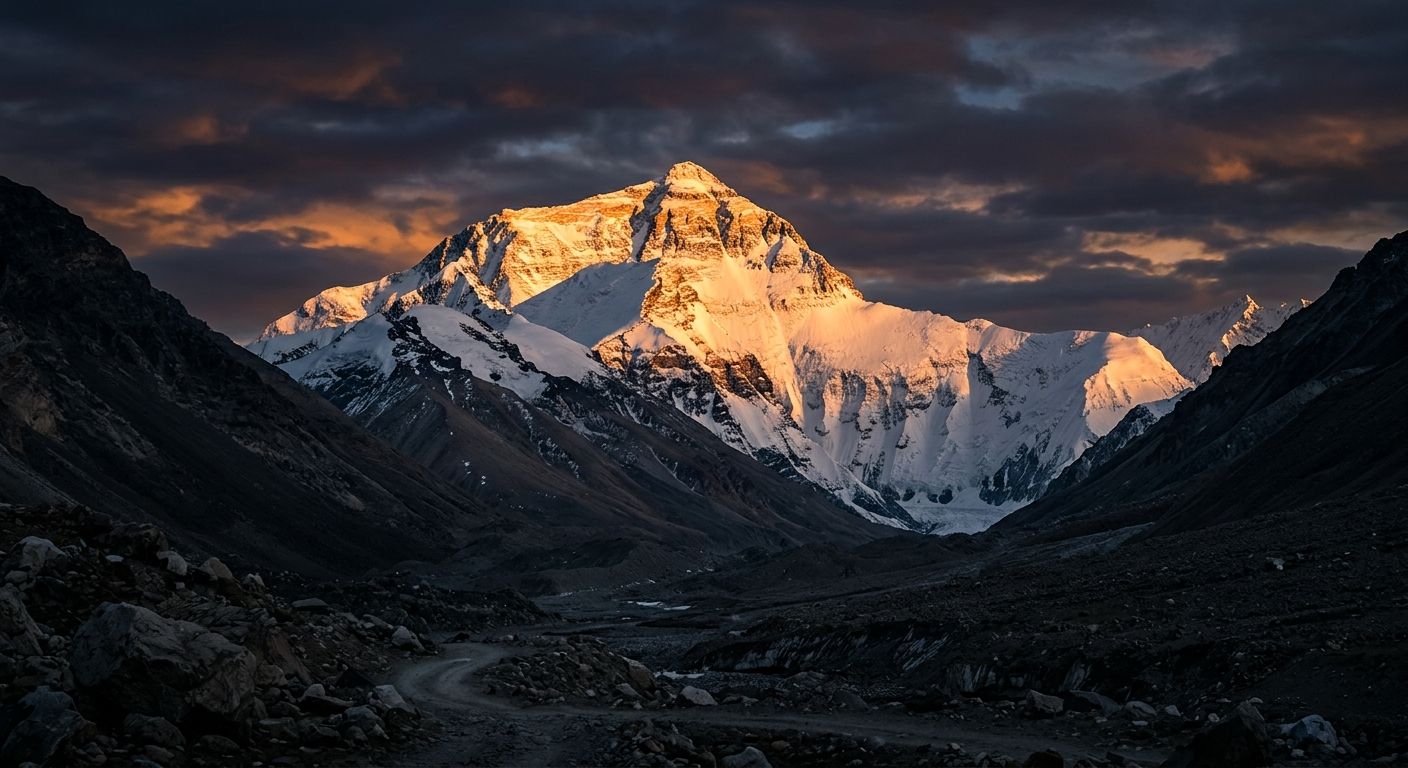
When most people picture Everest, they see the south face — the Nepal side, Khumbu Icefall, the crowded base camp with its colorful tent cities. That image has been photographed, filmed, and documented so thoroughly that it's become a commodity. A screensaver. A LinkedIn background.
The north face of Everest, accessed exclusively from Tibet, is a different proposition entirely.
The Difference Is Not Subtle
From the Tibetan side, Everest presents itself without obstruction. There are no neighboring peaks blocking the view. The north face rises from the plateau in a single, unbroken sweep of rock and ice — 3,500 vertical meters from base camp to summit, visible in its entirety.
The Nepal-side base camp sits at 5,364 meters in a glacial valley. You can see parts of Everest, but surrounding peaks compete for attention. The Tibetan base camp sits at 5,200 meters on an open plain. Everest dominates the horizon like a wall.
The Crowd Factor
Nepal's Everest Base Camp trek has become one of the world's most popular adventure tourism products. During peak season, the trail sees 40,000+ trekkers. Teahouses overflow. The "base camp selfie" has become a social media cliché.
The Tibetan side receives a fraction of this traffic. On any given day during our operating season, our guests may be the only people at the north face viewpoint. Not one of a hundred. The only ones.
This solitude is not accidental. It's partly a function of the permit system (which is more restrictive on the Tibetan side), partly geography (the approach requires private vehicle, not trekking), and partly the result of the global tourism industry's fixation on Nepal.
For our guests, all of these factors converge into a single outcome: you stand before the tallest mountain on earth in near-total silence, with a cinematic view that 95% of "Everest visitors" never experience.
The Sunset Protocol
On Day 5 of the expedition, we time our arrival at the north face viewpoint for late afternoon. As the sun descends, Everest's summit catches the last golden light — a phenomenon mountaineers call "alpenglow." The entire upper pyramid burns amber against a darkening sky.
This is when we deploy the drone.
A cinematic 30-second aerial portrait is captured with you and Everest in frame. Not a tourist snapshot. A properly composed, color-graded piece of footage delivered to your phone that evening over the vehicle's satellite internet.
After sunset, for guests who choose to stay, the zero-light-pollution environment reveals a night sky that redefines what you thought stars looked like. Our guides carry astrophotography references and assist with positioning for full-frame Milky Way captures.
This is not a photo opportunity. It's a confrontation with scale. Most guests describe it as the single most impactful moment of the expedition.