The Tibet Reserve
探索日志出发日期
私密咨询
Everest's North Face: The View Most Will Never See
The DestinationJanuary 2026·6 min read

Everest's North Face: The View Most Will Never See

By Bob Wang

95% of Everest tourism approaches from Nepal. The Tibetan north face — raw, unobstructed, and profoundly less crowded — is the version reserved for the few.

When most people picture Everest, they see the south face — the Nepal side, Khumbu Icefall, the crowded base camp with its colorful tent cities. That image has been photographed, filmed, and documented so thoroughly that it's become a commodity. A screensaver. A LinkedIn background.

The north face of Everest, accessed exclusively from Tibet, is a different proposition entirely.

01

The Mountain the British Tried First

The north face has a historical weight that the south side simply does not carry. Until Nepal opened to foreigners in the 1950s, the Tibetan approach was the only approach. Every serious attempt on Everest in the first three decades of its climbing history came from where our guests stand.

The British Reconnaissance Expedition of 1921 was the first Western party to map the approaches from Tibet, with George Mallory walking into the Rongbuk Valley and seeing what we now drive to. He returned in 1922 on the first true summit attempt. And in June 1924, Mallory and Andrew Irvine disappeared somewhere above 8,000 meters on the Northeast Ridge — last seen, in Noel Odell's famous sighting, "going strong for the top." Mallory's body was not recovered until 1999. Irvine has not been found.

Every view from the north face is also a view into that history. The Northeast Ridge, the First Step, the Second Step, the Great Couloir — these are not abstract features. They are the specific geography of the twentieth century's most consequential unfinished climb. We brief guests on this before arrival, because seeing the mountain without the story is a diminished encounter.

Nepal offers the summit Everest became. Tibet offers the mountain Everest was.

03

The Difference Is Not Subtle

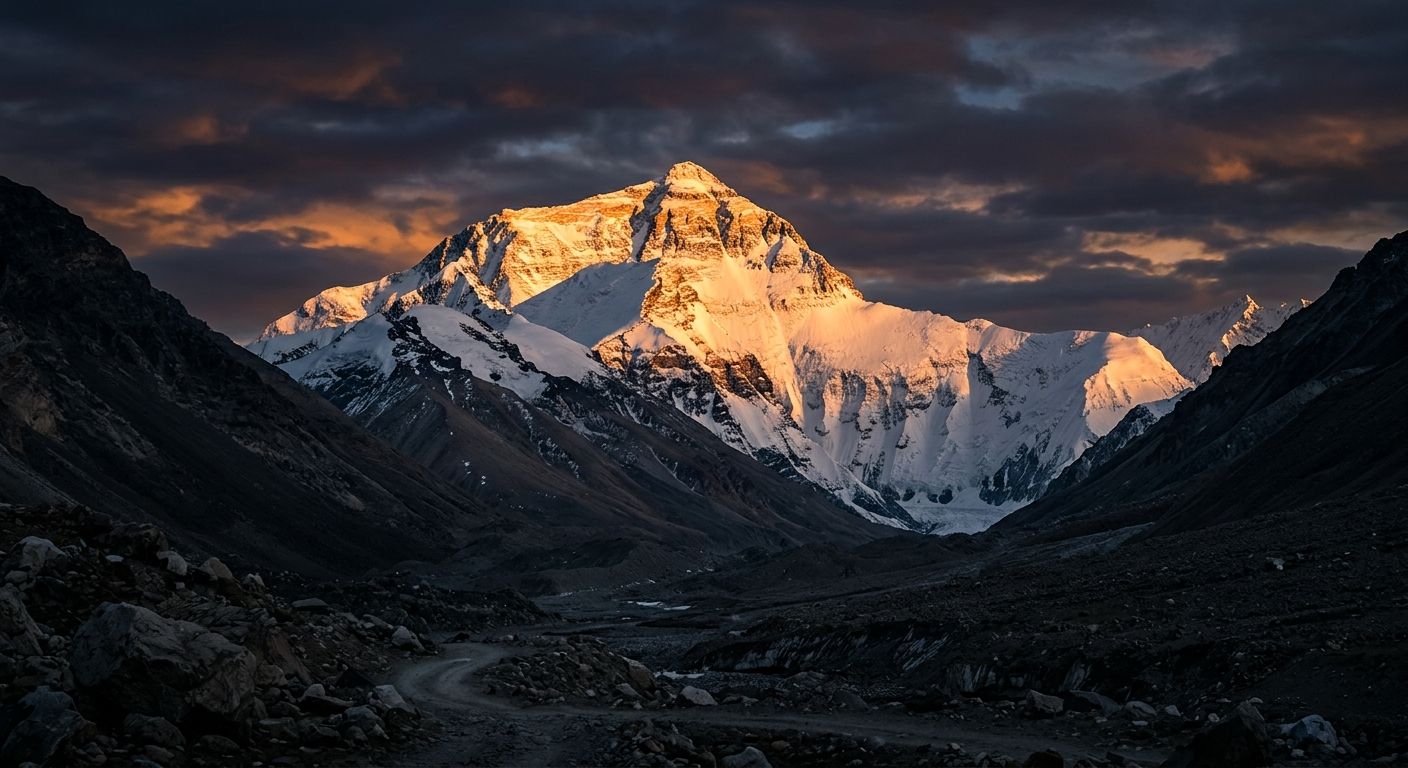
From the Tibetan side, Everest presents itself without obstruction. There are no neighboring peaks blocking the view. The north face rises from the plateau in a single, unbroken sweep of rock and ice — 3,500 vertical meters from base camp to summit, visible in its entirety.

The Nepal-side base camp sits at 5,364 meters in a glacial valley. You can see parts of Everest, but surrounding peaks compete for attention. The Tibetan base camp sits at 5,200 meters on an open plain. Everest dominates the horizon like a wall.

04

The Crowd Factor

Nepal's Everest Base Camp trek has become one of the world's most popular adventure tourism products. During peak season, the trail sees 40,000+ trekkers. Teahouses overflow. The "base camp selfie" has become a social media cliché.

The Tibetan side receives a fraction of this traffic. On any given day during our operating season, our guests may be the only people at the north face viewpoint. Not one of a hundred. The only ones.

This solitude is not accidental. It's partly a function of the permit system (which is more restrictive on the Tibetan side), partly geography (the approach requires private vehicle, not trekking), and partly the result of the global tourism industry's fixation on Nepal.

For our guests, all of these factors converge into a single outcome: you stand before the tallest mountain on earth in near-total silence, with a cinematic view that 95% of "Everest visitors" never experience.

06

The Friendship Highway and the Approach That Makes the View

Part of what makes the north face extraordinary is the geometry of getting there. The Friendship Highway — the overland route between Lhasa and the Nepal border — runs for roughly 800 kilometers across the plateau and delivers the mountain in deliberate stages, not as a single reveal.

From Lhasa at 3,650 meters, the road climbs through Gyantse and Shigatse, then west through Lhatse before turning south toward the Himalaya. The decisive moment is the Pang La pass at 5,248 meters, where the approach from the north bends into view. On a clear day, from that single vantage, you can see four of the world's six highest peaks — Makalu, Lhotse, Everest, and Cho Oyu — arrayed across the horizon simultaneously.

From Pang La, the road descends into the Rongbuk Valley. The altitude of viewpoints matters more than most guests expect:

  • **5,050 meters** — the Rongbuk Monastery approach, where the north face first appears framed by the valley walls.
  • **5,200 meters** — the base camp viewpoint itself, the classic head-on composition.
  • **5,248 meters** — the Pang La summit, the panoramic vantage.
  • **5,545 meters** — the advanced viewpoint above the monastery, reached on foot for guests who are acclimatized and asking for it.

Each altitude is a different photograph. We shoot all of them, if the weather cooperates.

08

Rongbuk Monastery: The Highest in the World

At 4,980 meters, Rongbuk Monastery is commonly cited as the highest functioning monastery on earth. It was founded in 1902 by Ngawang Tenzin Norbu, and during the British expeditions of the 1920s the climbers sought blessings here before ascending into the valley. Expedition photographs from that period show the same silhouette our guests see today: the chorten in the foreground, the prayer wall, and the north face of Everest rising almost impossibly behind.

The monastery is functioning, inhabited, and open to respectful visitors. We do not stage experiences here. We arrive quietly, at a pace that allows guests to circumambulate the chorten if they wish, and we leave. The pairing of a century-old Tibetan Buddhist institution with the mountain's north face, in a single frame, is one of the most photographed compositions in Himalayan history for a reason.

09

The Hours That Matter

Not all light at Everest is equal. Our itinerary is built around four specific windows:

First light, roughly 06:15 to 06:45 in late season. The sun rises behind the observer in the Rongbuk Valley and hits the north face before anything else in the landscape. For twenty minutes the mountain is lit and the plain is still in shadow. Cold, uncomfortable, worth every minute.

Mid-morning, 09:30 to 11:00. The cleanest, most stable air of the day. Pennant clouds — the banner of ice crystals streaming east from the summit — are typically sharpest in this window.

Late afternoon alpenglow, roughly 17:30 to 18:15. The classic shot. The summit pyramid catches the last direct sunlight while the valley cools to indigo.

After astronomical twilight. This is the Rongbuk signature. At 5,200 meters with zero industrial light pollution in any direction, the Milky Way's galactic core rises over the north face during operating season. Jupiter and Saturn are visible to the naked eye as discs, not points. Our guides position a tripod and assist with 15- to 20-second exposures at wide aperture. We do not oversell this; we simply ensure guests are outside, warm, and looking up when the sky arrives.

11

The Sunset Protocol

On Day 5 of the expedition, we time our arrival at the north face viewpoint for late afternoon. As the sun descends, Everest's summit catches the last golden light — a phenomenon mountaineers call "alpenglow." The entire upper pyramid burns amber against a darkening sky.

This is when we deploy the drone.

A cinematic 30-second aerial portrait is captured with you and Everest in frame. Not a tourist snapshot. A properly composed, color-graded piece of footage delivered to your phone that evening over the vehicle's satellite internet.

After sunset, for guests who choose to stay, the zero-light-pollution environment reveals a night sky that redefines what you thought stars looked like. Our guides carry astrophotography references and assist with positioning for full-frame Milky Way captures.

This is not a photo opportunity. It's a confrontation with scale. Most guests describe it as the single most impactful moment of the expedition.

About the Author

BW

Bob Wang

Founder, The Tibet Reserve

Bob Wang is the founder of The Tibet Reserve. Over the past decade he has traveled the Tibetan Plateau more than forty times, building relationships with local operators, monastic communities, and permit authorities that make genuinely private expeditions possible. He writes from direct experience — not a desk.

Begin

Ready to experience this yourself?

Every expedition begins with a conversation. No commitment required.

Request a Private Consultation